Telehealth Platform: Custom Build vs. White-Label vs. Self-Hosted – Your HealthTech Reality Check
Choosing your telehealth platform isn’t just a tech decision. It’s a strategic move for your HealthTech.
This guide cuts through the noise. We break down custom builds, Teladoc/MDLive white-label options, and self-hosted solutions. Get ready for real talk, not fluff.
You know what’s tough in HealthTech today?
Navigating the “build or buy” maze. This is especially true with telehealth.
In the US, Canada, and UK, regulatory landscapes shift. Patient expectations grow. Your competitors are not sleeping.
Choosing the right platform is critical. It defines your agility. It impacts your resilience. Plus, it affects your bottom line.
Are you struggling to pick the right path?
Good. We see this challenge daily. You are not alone.
True digital resilience in healthcare starts with owning your core technological destiny.
— Dr. Anya Sharma, Digital Health Strategist
The Big Question: What’s Your Long Game?
Let’s be real. There isn’t one magic bullet. Your choice depends on your vision.
It hinges on your resources. It also comes down to your tolerance for vendor lock-in.
We are talking about three main contenders here. Each has its own baggage. And each has its own superpowers.
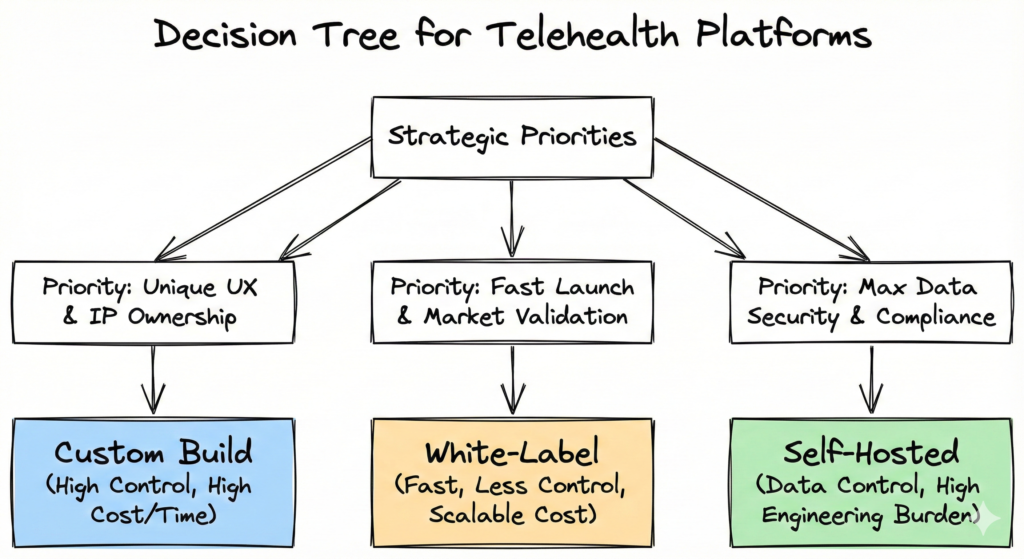
Option 1: The Custom Build – Master of Your Own Universe
This path means building from scratch. Or at least, building with highly customized core components.
It’s an investment, for sure. But it offers unparalleled control.
- The Upside:
- Total Control & IP: You own everything. Your intellectual property is yours alone. No surprises from a vendor.
- Perfect Fit: Your platform mirrors your specific workflows. It serves your unique patient journeys. Consider bespoke care models for Canadian provinces. Or consider nuanced NHS service integration in the UK.
- Future-Proofing: You dictate the roadmap. You adapt to new regulations (like evolving HIPAA guidelines in the US or data sovereignty in Canada) directly. You do not wait for a vendor to catch up.
- Deep Integration: Seamlessly connect with your existing EHRs, CRMs, or other internal systems. No clunky workarounds are needed.
- The Downside:
- High Upfront Cost: Engineering talent isn’t cheap. Neither is infrastructure.
- Time to Market: This isn’t a weekend project. It takes time to build robust, secure, and compliant systems.
- Resource Intensive: You need a strong in-house team. Alternatively, find a trusted engineering partner. We know this reality.
- Maintenance Burden: You own the bugs. You own the updates. That’s a continuous investment.
- Compliance Headaches: HIPAA, PHIPA, GDPR. You are responsible for meeting every single letter of the law. This is a significant undertaking for US, Canadian, and UK operations.
You know what’s the kicker here?
A custom build, done right, is an asset. It is not just an expense. It future-proofs your enterprise. It truly makes your brand resilient.
Option 2: White-Label Platforms (Teladoc/MDLive) – Speed & Convenience
These are pre-built, ready-to-deploy solutions. You slap your logo on them. Then you get going. Fast.
- The Upside:
- Rapid Deployment: Need to launch yesterday? This is your fastest route.
- Lower Upfront Costs: These are typically subscription-based. They involve less capital expenditure initially.
- Proven Tech: These platforms are established. They have existing user bases.
- Vendor Handles Compliance (Mostly): They generally adhere to broad regulatory frameworks. However, “broad” does not mean “specific” to your unique service line or local nuances.
- The Downside:
- Vendor Lock-in: You are tied to their ecosystem. Exiting can be painful. It can also be expensive.
- Limited Customization: Do you want a specific feature? You are stuck with what they offer. This really impacts unique care models.
- Branding Dilution: It still feels like their platform, not truly yours. This can subtly erode patient trust over time.
- Data Ownership & Portability: Who truly owns the patient data? Can you easily export it if you leave? Often, it is not as straightforward as you hope.
- Scaling Costs: Subscription models scale with usage. High growth can mean significantly higher costs down the line. That fast start quickly becomes pricey.
- Regional Nuances: While they cover broad strokes, specific regional compliance can be a headache. For example, consider nuances for prescribing in specific US states. Or think about integrating with provincial health records in Canada.
Guess what?
White-label is great for testing the waters. But for long-term strategic growth in HealthTech, it often creates more limitations than it solves.
Option 3: Self-Hosted Solutions (e.g., Open Source + Your Infrastructure) – The Hybrid Approach
This involves taking an existing software solution and hosting it on your own servers. This could be an open-source solution, like OpenEMR built for telehealth. Or it could be a commercial self-deployable platform.
You manage both the infrastructure and the software.
- The Upside:
- Data Sovereignty: Your data stays on your infrastructure. This is critical for privacy laws in the US, Canada, and UK.
- Customization Potential: If it’s open source, you can modify it. You tailor it to your needs.
- No Vendor Lock-in (for Open Source): You control the code. You control the destiny.
- Potentially Lower Long-Term Costs: There are no recurring vendor fees for the platform itself. You pay for infrastructure and engineering resources.
- The Downside:
- Significant Engineering Burden: This is not just “install and forget.” It requires a robust team for deployment, maintenance, security, and updates.
- Security Responsibility: You are 100% responsible for protecting sensitive patient data. This is a massive undertaking.
- Compliance Management: The entire regulatory burden falls on you. You need expertise in HIPAA, PHIPA, GDPR, and local health authority requirements.
- Feature Development: If the open-source base lacks a feature, you must build it. Alternatively, you can pay someone to build it.
- Scalability Challenges: You manage the infrastructure scaling. This takes careful planning and execution.
You know what hurts?
Thinking self-hosting is “free” because the software is open source is a common mistake.
The operational and engineering costs can quickly outstrip white-label options. This happens if you lack the internal capacity.
The Verdict: What Should You Do?
Alright, let’s cut to the chase. There is no “it depends.” We are giving you the play.
For most ambitious HealthTech enterprises in the US, Canada, and UK, a custom-engineered platform is the strategic choice.
Why?
It offers true resilience. It delivers competitive differentiation. It also provides the agility needed to thrive in a rapidly evolving market.
White-label solutions are a short-term patch. They often lead to vendor dependency. Furthermore, they stifle innovation.
Self-hosted can work. However, you must have a world-class engineering team ready for a massive commitment.
Your patients deserve systems that truly understand their needs. Your clinicians require tools that enhance, not hinder, their work.
This is where Sociazy’s enterprise solutions come in.
We do not just build software; we engineer resilient systems. We navigate intricate regulatory landscapes.
This allows you to focus on care, not code.
Think about your long-term success. Think about ownership. Think about the unique value you bring.
Custom is where that happens.
This is not just about building; it is about engineering a future. A future where your HealthTech is not just surviving, but truly leading.
Ready to stop guessing? Book Your Free Consultation
“`