
Why Legacy EHR Systems Are Failing Patient Data Interoperability (FHIR 2026)
Your Electronic Health Record (EHR) system should be a wellspring of patient data, not a digital fortress. For many HealthTech leaders, however, legacy EHRs create costly data silos. These systems hinder patient care and fail to meet critical interoperability deadlines like FHIR 2026 across the US, Canada, and the UK. This isn’t just an IT headache; it’s a strategic liability.
You know what hurts? You spend a massive budget on an EHR system year after year, yet you still get zero real-time data flow. You constantly battle manual workarounds. You stare down regulatory deadlines, like the impending FHIR interoperability requirements, with a knot in your stomach. This is frustrating, right?
We see it all the time. Your organization invests heavily. You expect a seamless exchange of patient information. But the reality is a patchwork of disjointed systems.
Is Your EHR a Data Fortress or a Pathway?
Let’s be real. Most legacy EHRs weren’t built for interoperability. They were designed for billing and documentation within a single clinic or hospital.
This fundamentally limits their ability to share data.
Think about it. These systems often operate like walled gardens. Data enters, but it rarely leaves easily.
Getting information out means complex, custom integrations. These are expensive, fragile, and prone to breaking.
This isn’t just an American problem. In the UK, NHS trusts wrestle with countless bespoke integrations. These hinder unified care records for integrated care systems (ICSs).
Canadian provinces face similar challenges. Each has unique data standards. This complicates a national connected health vision.
The result? Fragmented patient views. Doctors can’t get full histories quickly. Nurses spend precious time hunting for data. Patients feel the impact directly.
“Data silos aren’t just an IT issue; they’re a direct threat to patient safety and operational efficiency.”
— Dr. Evelyn Reed, HealthTech Strategy Advisor
What About FHIR 2026? It’s More Than an API.
You’ve heard about FHIR (Fast Healthcare Interoperability Resources). It’s the new lingua franca for health data. It’s not just a technical standard. It’s a regulatory imperative, especially in the US with the ONC Cures Act.
The push for FHIR isn’t slowing down. We see similar drives in Canada and the UK. NHS Digital leans heavily into FHIR, supporting their long-term data strategy.
Health Data Research UK also champions open standards.
Here’s the kicker: many legacy EHRs just can’t speak FHIR natively. They weren’t designed with modern API principles. Integrating FHIR into them often means building a translator layer. This adds complexity and cost.
Guess what? The 2026 timeline for full FHIR adoption, while varying slightly by jurisdiction, is coming fast. Ignoring it isn’t an option.
Non-compliance means potential penalties. It also means falling behind competitors. More importantly, you risk failing your patients.
The Legacy System Data Flow Nightmare
Imagine your current data flow. It probably looks something like this:
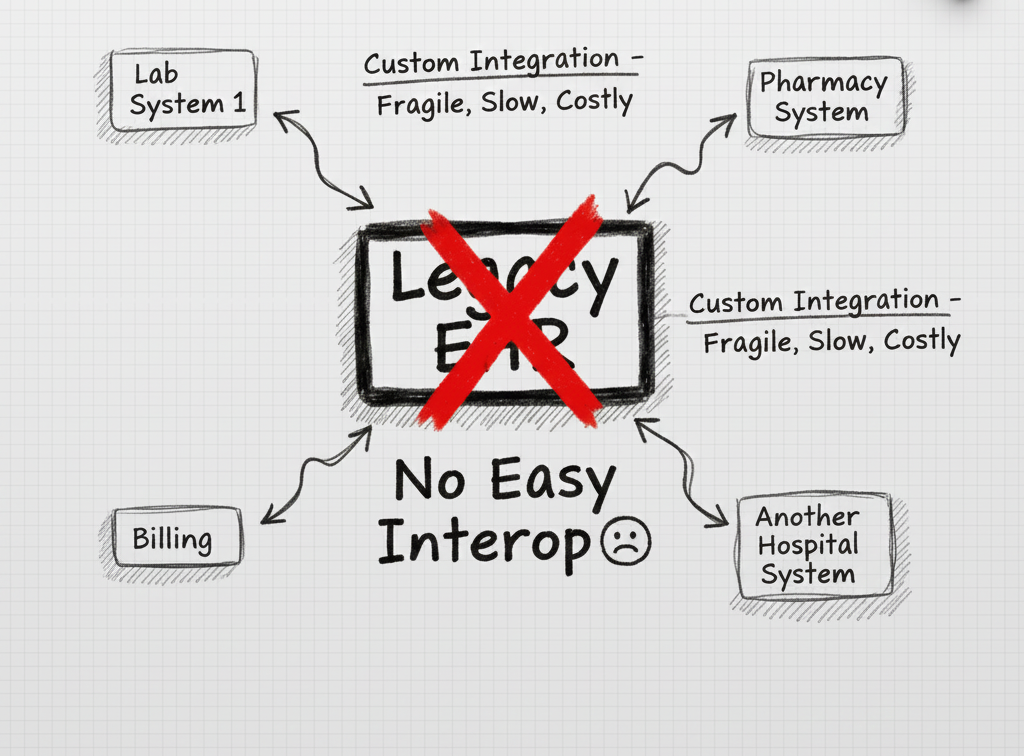
See that? Every connection is a bespoke project. It’s not sustainable.
This isn’t just about integrating with a single lab. Instead, it involves exchanging data securely across entire health systems. Think about population health initiatives and personalized care.
This challenge is universal. In the US, TEFCA aims for national data exchange. How will your legacy system connect?
In Canada, provincial efforts push for integrated patient records. Can your EHR keep up? The UK’s ICS vision depends on fluid data movement.
So, What’s the Actual Fix?
You don’t need another generic “digital transformation” pitch. You need actionable steps. Let’s talk about the technical reality.
We’ve helped HealthTech enterprises navigate this. Here’s our 3-step solution:
Strategic Data Architecture Assessment, Not Just Upgrades.
- Don’t just patch your existing EHR. Instead, start with a deep dive.
- Understand your specific data flows. Identify critical choke points.
- Map out your existing integration landscape. Determine what’s working and what’s failing.
- This isn’t about replacing everything. It’s about smart augmentation. We focus on your specific needs and challenges.
- You need a clear roadmap. This roadmap should align with your business goals and compliance requirements.
Build an API-First Integration Layer (FHIR Native).
- Think microservices. Create a robust, modern data fabric around your EHR.
- This layer acts as a universal translator. It converts legacy data into FHIR and exposes it securely via APIs.
- This approach decouples your core EHR. It frees your data and allows new applications to connect easily.
- Consider this your “interoperability engine.” It empowers faster innovation, ensures compliance, and gives you control over your data.
- This isn’t just about getting data. It’s about governing it.
Implement a Secure, Scalable Integration Platform.
- Move beyond simple point-to-point connections. You need a platform approach.
- This platform should handle authentication and authorization. It must log every data transaction.
- Focus on resilience. Your system needs to stay up and handle high volumes.
- Security isn’t an afterthought; it’s foundational. Non-negotiable compliance includes HIPAA, GDPR, and PIPEDA.
- This strategy helps you move toward true enterprise solutions. It sets you up for future growth and makes your digital transformation real.
The cost of inaction is far greater than strategic investment. You lose insights and risk patient safety. You also open yourself to regulatory fines and hinder innovation.
Your legacy EHR might be a necessary evil for now. However, its limitations don’t have to define your future. With the right engineering approach, you can unlock your data, prepare for FHIR 2026, and build resilient systems.