
The ‘Frankenstack’ Is Silently Killing Your Martech ROI
An inefficient tech stack is a silent killer of growth. We recently completed a Martech stack audit of 50 high-growth B2B companies. The findings were alarming: 80% had significant budget overlap and tool redundancy.
This marketing technology waste directly drains the B2B marketing budget. More importantly, it kills your team’s efficiency and craters your Martech ROI.
The problem is the “Frankenstack.” It is a monster built from bolted-on tools. Each tool was bought to solve one small problem. Now, they barely talk to each other. Consequently, your team spends more time managing the tools than driving growth. Before you buy another “must-have” platform, see if you are already paying for these three culprits.
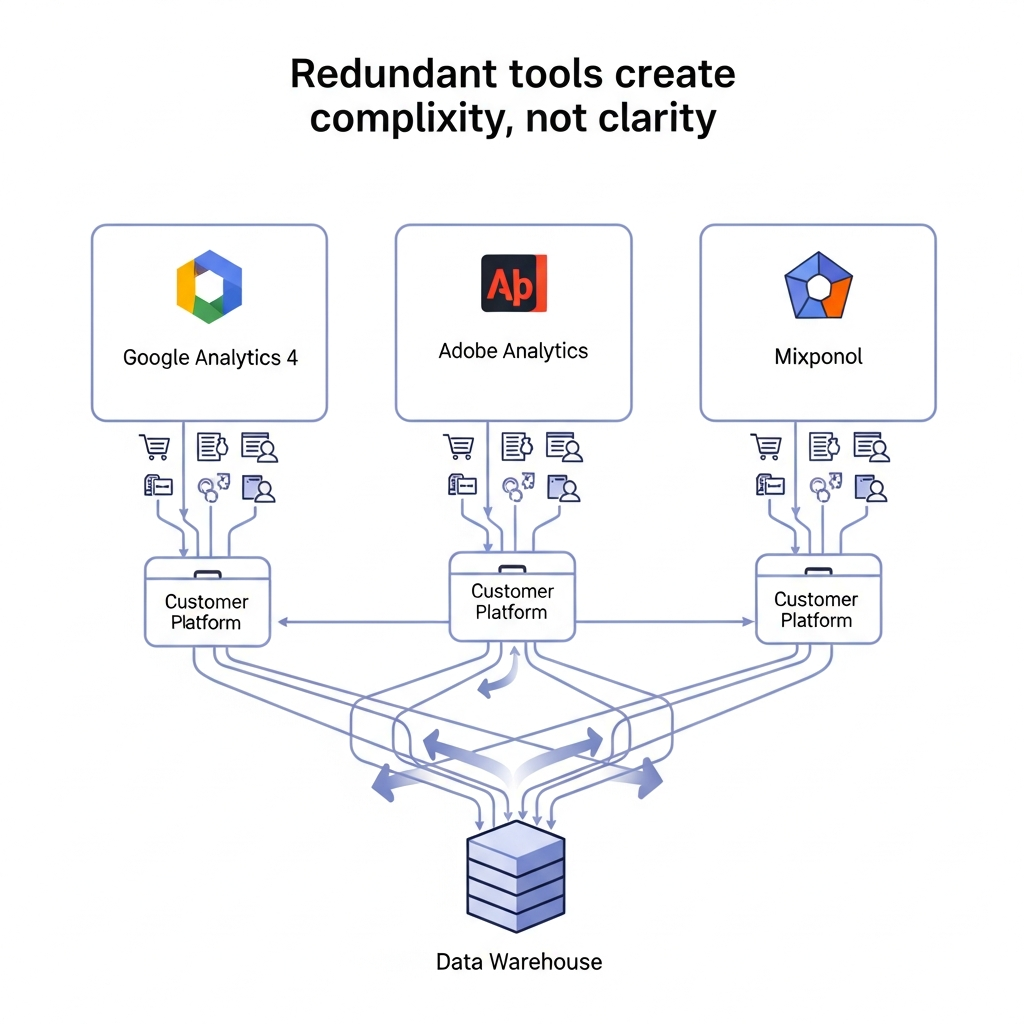
Culprit 1: Redundant Data & Analytics Tools
This is the most common waste we found. A company has a core analytics platform (like Google Analytics 4). They also have a BI tool (like Tableau or Power BI). Then, we find another $20,000/year subscription for a specialized heatmap and session recording tool.
The problem? The core analytics and BI tools can often perform these functions already. The team just was not trained to use them.
This redundancy is fueled by “shiny object syndrome.” A new tool promises a simpler dashboard. However, it only pulls data from other systems. It creates another data silo instead of providing new insight. This redundancy drains the B2B marketing budget for zero added value.
Culprit 2: The Over-Purchased “Enterprise ABM” Platform
Many B2B companies are sold a powerful, all-in-one Account-Based Marketing (ABM) platform. These tools cost $100,000 or more per year. They promise to align sales and marketing perfectly.
The reality is different. We found that most teams use less than 20% of the features they pay for.
They use the tool for basic ad targeting and account lists. The advanced lead scoring, multi-touch attribution, and predictive modeling features are left untouched. Why? Because they were never properly integrated with the CRM. The platform becomes expensive “shelfware.” A Martech stack audit often reveals that 80% of the tool’s value is wasted.
Culprit 3: Siloed Tools That Create More Work
The third culprit is the most dangerous. This is the collection of tools that claim to integrate but do not.
Your CRM, your marketing automation platform, and your sales enablement tool all have their own “source of truth.” Consequently, your marketing team is manually exporting CSV files. Your sales team is working from outdated contact lists. Data hygiene becomes a full-time job.
Recent research from Gartner highlights this exact problem. Their surveys show that martech utilization has plummeted, with marketers using just 33% of their stack’s capabilities. This is a massive drop from 42% in 2022 and 58% in 2020. Teams are officially drowning in tools they cannot use effectively.
This friction is where Martech ROI goes to die. Teams then try to buy another tool, like a Customer Data Platform (CDP), to fix it. However, this just adds another layer of cost and complexity to a broken foundation.
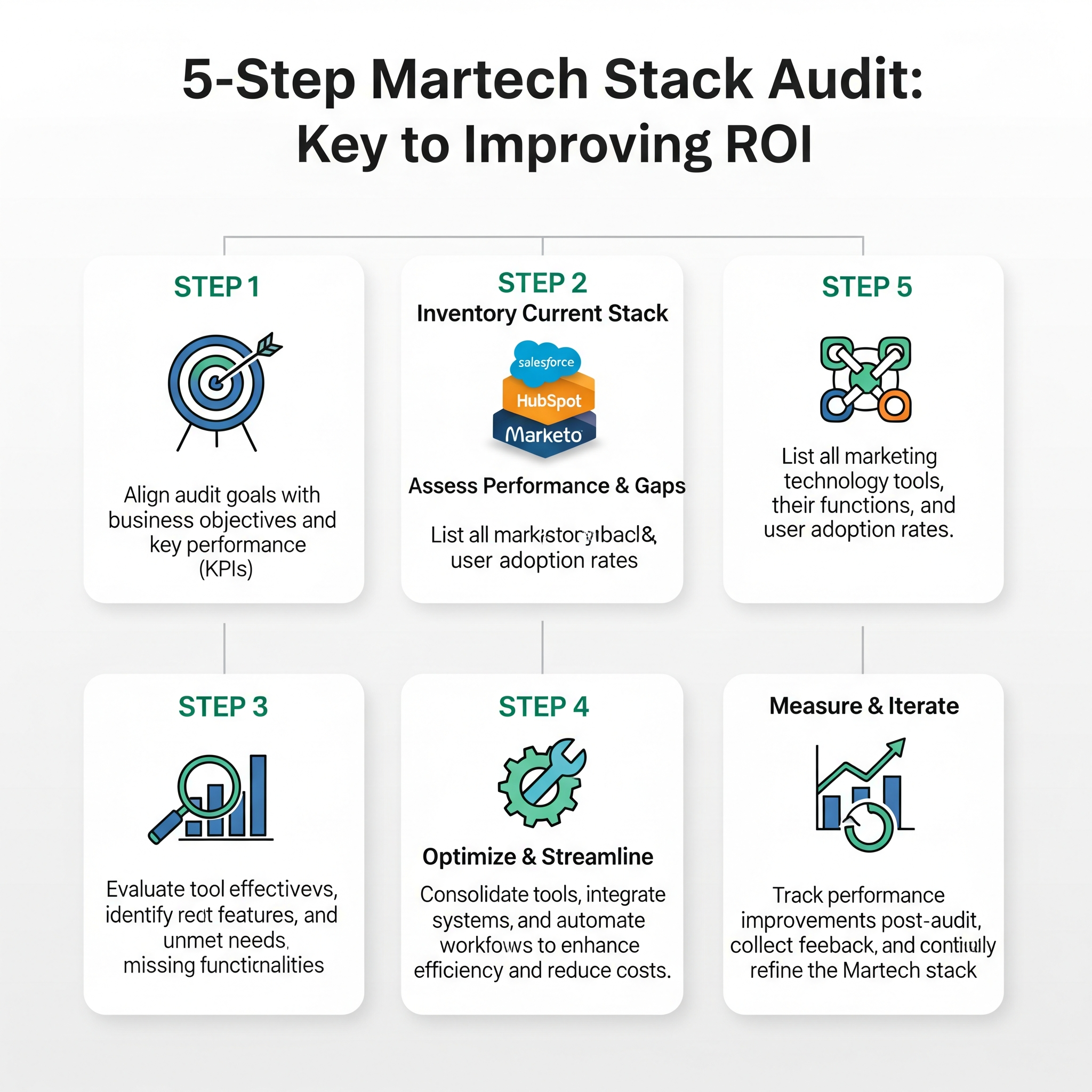
The 5-Step Martech Stack Audit to Recapture Your Budget
You can fix this. A simple, ruthless Martech stack audit will reveal your biggest opportunities for savings and efficiency.
Do this every six months.
- Inventory (What do we have?): List every single tool used by marketing, sales, and customer success. List its owner, cost, and renewal date.
- Usage (Who really uses it?): Ask the owner to pull a usage report. How many people logged in last month? If less than 50% of the licensed users are active, it is a red flag.
- Overlap (What does it really do?): Map the core function of each tool. Do you have three tools that all “send emails”? Do you have two tools that “track website visitors”? This is your consolidation list.
- Integration (How does it talk?): Does this tool have a deep, native integration with your core CRM? Or does it rely on a brittle, third-party connector (or worse, a manual export)? If it does not connect, its value is minimal.
- ROI (Does it drive revenue?): Ask the tool’s owner one question: “Can you prove this tool directly contributed to a closed-won deal in the last quarter?” If the answer is “no” or “it’s complicated,” it is on the chopping block.
Case Snippet: How We Saved a Client $120k by Optimizing One Workflow
We recently performed a Martech stack audit for a B2B SaaS client. Their B2B marketing budget was bloated. Their lead-to-sales handoff was slow and manual.
- The Problem: They were paying for an enterprise marketing automation platform ($80k/year), a separate lead-routing tool ($25k/year), and a data-cleansing tool ($15k/year).
- The Audit: We found their new CRM (HubSpot) could perform 90% of all three functions natively. The team was simply using legacy workflows.
- The Solution: We migrated their workflows into the CRM. We built a single, automated process for lead routing, scoring, and cleansing inside the tool they already owned.
- The Result: They eliminated three redundant tools, saving $120,000 in annual licensing fees. Speed-to-lead improved by 400%.
Stop Buying Tools. Start Building an Engine.
Your tech stack should be a growth engine, not an anchor. The problem is not the tools themselves. The problem is the lack of a central, integrated strategy.
The golden takeaway from our audits is simple: Stop buying more. Start integrating better.
A ruthless Martech stack audit does more than just trim your B2B marketing budget. It forces you to simplify. It removes friction for your teams. Most importantly, it shifts your focus from managing software to driving revenue. That is the true measure of Martech ROI.
🚀 Build a Stack That Grows With You
Your tech stack should enable your strategy, not define it. If your “Frankenstack” is holding you back, it is time for an engineering-led growth approach.
The Sociazy team specializes in auditing, integrating, and optimizing complex B2B tech stacks to drive measurable revenue.
Book a Free Martech Strategy Consultation Today!