In the high-stakes world of fintech, your payment gateway is more than just a pipe for money—it is the defining factor of your user retention. With the global payment gateway market projected to hit $31.44 billion in 2025, the technology you choose today will determine your ability to scale tomorrow. However, a staggering 25% of users still abandon transactions due to untrustworthy payment interfaces. For fintech leaders, the question isn’t just “how do we get paid?” but “how do we optimize every transaction?” This guide dissects the three dominant strategies to help you choose the right path.
The Strategic Trilemma: Cost, Coverage, and Control
Every engineering and product leader eventually hits the “Payment Trilemma.” You can usually optimize for two of the following three, but rarely all of them simultaneously:
- Speed to Market: How fast can you deploy?
- Global Coverage: Can you accept PIX in Brazil and UPI in India tomorrow?
- Margin Control: How much of the transaction fee do you keep?
Choosing the wrong architecture early on can lead to massive technical debt. A platform optimized for US credit cards might face 40% failure rates in Southeast Asia if it lacks local switching logic.
The Case for Global Aggregators (Stripe & Adyen)
For 90% of startups, global aggregators are the default choice. They solve the complexity of PCI compliance and offer a developer experience that is second to none.
- The “Pro” Argument: You get instant access to 135+ currencies and fraud tools like Stripe Radar. The documentation is world-class, allowing junior devs to integrate payments in days.
- The “Con” Argument: You pay a premium for convenience. Standard fees (often 2.9% + 30¢) hemorrhage revenue once you hit high transaction volumes. Furthermore, you are renting their risk license—if they flag your business model, they can freeze your funds instantly.
We advise Seed and Series A clients to eat the higher fees of global aggregators. At this stage, your engineering time is more valuable than saving 0.5% on transaction costs.”
The Power of Local: Why Regional Players Win
If your fintech targets specific high-growth markets, a “one-size-fits-all” global gateway often fails. Regional champions like Razorpay (India), PayU (LatAm/EMEA), or Flutterwave (Africa) offer critical advantages.
- Higher Success Rates: Because they integrate directly with local banking rails (rather than routing through international networks), transaction success rates are often 10-15% higher.
- Cultural Nuance: They natively support alternative payment methods (APMs) that global giants might treat as afterthoughts. In 2025, supporting methods like Buy Now, Pay Later (BNPL) natively is not optional—it’s a baseline expectation. [Link to Sociazy’s Fintech Market Analysis]
Building Your Own: The Custom API Route
This is the “nuclear option” for mature fintechs. Building a custom gateway or orchestration layer on top of acquiring banks gives you ultimate power, but it comes with heavy responsibility.
- Margin Mastery: By negotiating directly with backend acquirers, you can drive fees down significantly, potentially saving millions annually at scale.
- Data Sovereignty: You own the tokenized data. This prevents vendor lock-in and allows you to route transactions to different providers dynamically based on who offers the lowest fee or highest success rate at that moment.
Decision Framework: Scaling from MVP to Unicorn
When should you switch strategies? Use this roadmap:
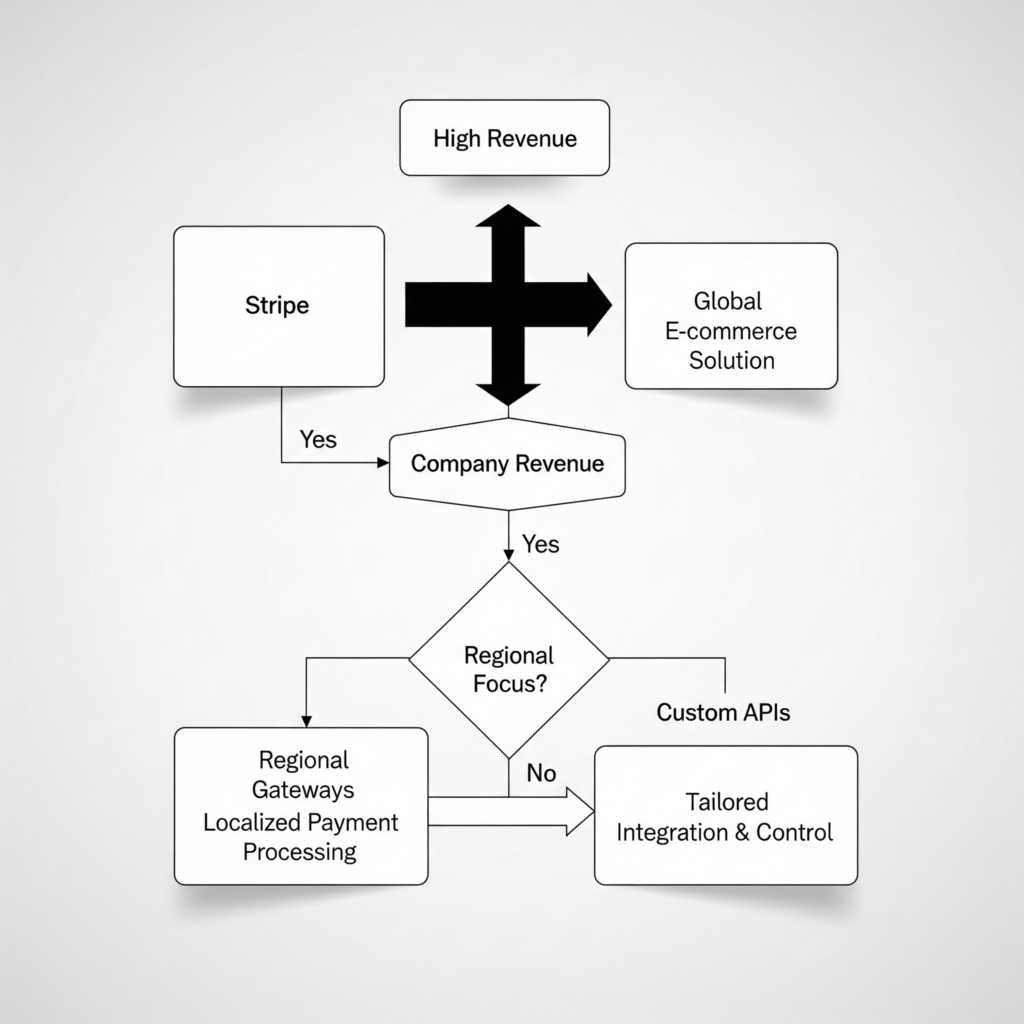
- Phase 1 (Validation): Use Stripe/PayPal. Focus on product-market fit. Do not waste cycles on complex billing infrastructure.
- Phase 2 (Expansion): Layer in Regional Players. As you enter specific markets (e.g., launching in Indonesia), add a local provider to handle domestic traffic.
- Phase 3 (Optimization): Build Custom Orchestration. Once you process >$50M GMV annually, build an internal router to switch between providers intelligently.
Conclusion
The “Stripe vs. Custom” debate is a false dichotomy. The most successful fintechs evolve their stack, starting with aggregators for speed and graduating to custom orchestration for scale. With 17% of shoppers abandoning carts due to trust issues with credit card forms, your priority must always be a seamless, secure user experience. Don’t let your payment stack become the bottleneck to your growth.
Ready to Transform Your Fintech Strategy?
Stop wondering and start transforming. Contact Sociazy’s expert team today for a no-obligation consultation on how we can solve your specific Fintech challenges.