The New Mandate: Automation in Modern Wealth Management
The wealth management landscape is changing fast. Today’s clients demand immediate, personalized service. They expect proactive advice and digital simplicity. The only way to deliver this at scale is through AI-driven automation. Ignoring this shift is no longer an option. Firms must transition from manual processes to intelligent, autonomous systems. The transformation from traditional advice to AI-powered insights is already underway.
1. Hyper-Personalization at Scale
Clients want personalized advice, not generic models. AI analyzes vast, disparate datasets instantly. It processes transaction histories, risk tolerance, and real-time behavioral data. This depth of analysis allows for truly unique investment strategies.
AI identifies life events like new jobs or market shifts quickly. The system automatically refines strategies without waiting for manual reviews. This ensures clients receive the most relevant offerings instantly. Wealth managers achieve deep customization for thousands of clients simultaneously. This level of service was impossible just a few years ago.
In the new era of finance, personalization is the ultimate scalability. AI moves us from segmenting clients to serving segments of one.”
2. Automated Portfolio Optimization & Rebalancing
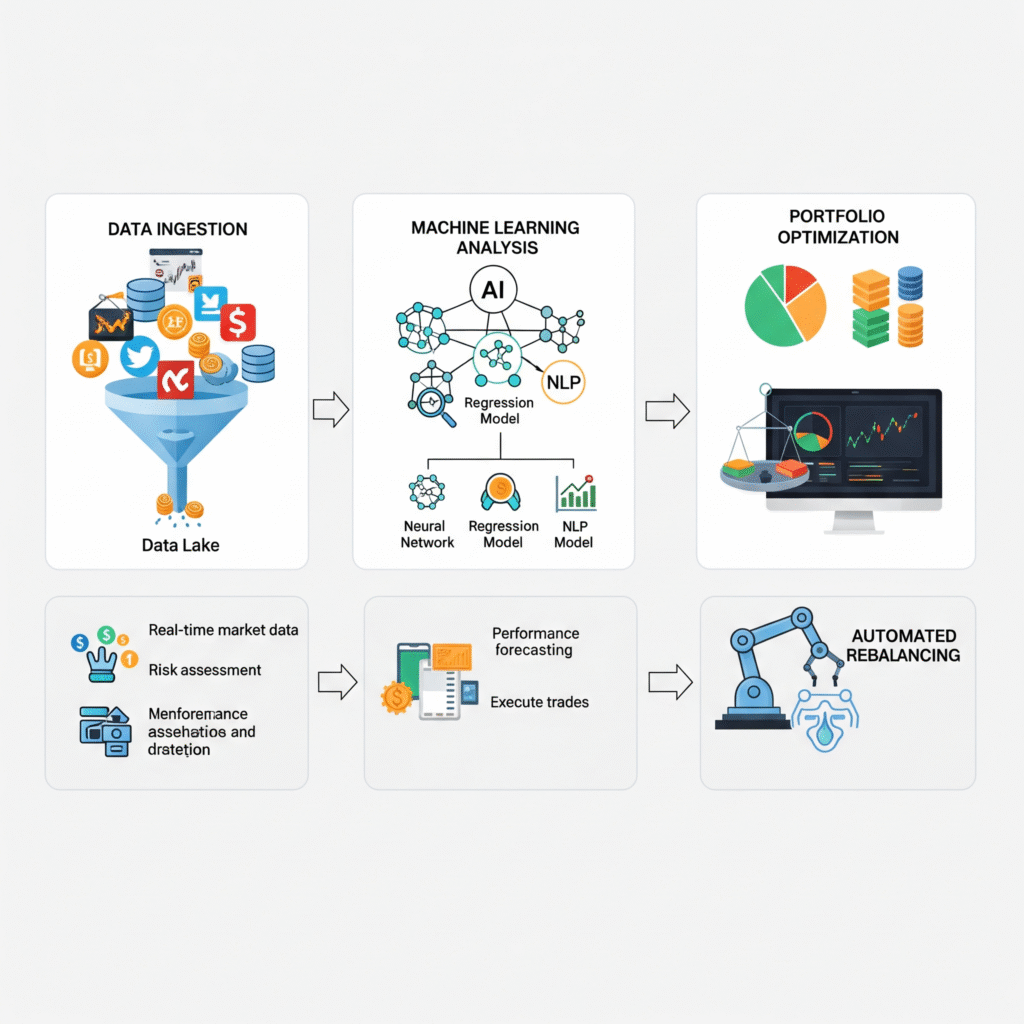
AI algorithms are fundamentally changing portfolio management. They continuously monitor assets and market signals in real time. This dynamic approach replaces periodic, static human reviews.
Machine learning models evaluate millions of data points every second. They identify complex patterns and correlations human analysts often miss. This allows for optimal asset allocation strategies. AI in Wealth Management executes tax-loss harvesting and rebalancing autonomously. This keeps portfolios aligned with client goals and specific risk profiles. A common result is superior alpha generation.
3. Next-Generation Risk Management & Stress Testing
Traditional risk management is often reactive and slow. AI provides a proactive, predictive capability. It uncovers hidden risks across asset classes quickly. This includes credit default and geopolitical shifts.
AI models run thousands of “what-if” scenarios instantly. They measure portfolio resilience against economic downturns or major events. They can autonomously initiate portfolio adjustments when specific risk thresholds are breached. This ability to act fast strengthens portfolio performance. It also ensures greater resilience against market volatility.
4. Real-Time Compliance and Fraud Detection
The regulatory environment in Fintech is complex and ever-changing. AI-Driven Automation embeds compliance rules directly into workflows. This includes regulations like MiFID II and GDPR. The system monitors client communications and trade flow in real time.
Advanced AI algorithms flagged 98% of fraudulent applications in real time in 2025. This drastically reduces compliance risks. If a suspicious activity is detected, the AI automatically halts the transaction. It then immediately alerts the compliance team. This ensures quick, decisive action to uphold all necessary compliance standards.
5. Enhanced Client Onboarding and KYC
The Know Your Customer (KYC) process is historically paper-heavy and slow. This creates friction and client drop-off. AI streamlines this entire workflow. It automates document verification and data extraction.
This significantly reduces manual effort and speeds up processing times. AI-driven systems processed 40% more applications per day compared to manual methods in 2025. This allows firms to scale rapidly without compromising due diligence. The result is a seamless, secure, and rapid client experience. This strong start builds crucial client trust.
6. Advisor Productivity via Agentic Automation
Agentic Automation is the next step in this evolution. These are specialized AI systems that act autonomously to achieve complex goals. They are designed to augment the human advisor. Agentic AI can generate client reports, summarize market insights, and handle routine administration. This frees up significant advisor time.

One major firm used AI agents to achieve 32% higher productivity rates in 2025. Advisors now focus their energy on strategic client conversations. This human-AI collaboration drives better outcomes and enhances client satisfaction.
7. Democratization of Financial Advice
Historically, personalized wealth management was reserved for the ultra-rich. High fees and human capacity created barriers. AI is breaking these barriers down entirely.
Robo-advisors powered by AI offer scalable, low-cost advisory solutions. They provide tailored investment advice to a much broader demographic. This ensures everyone can access sophisticated financial planning tools. This democratization creates a new, massive market for innovative firms. It solidifies AI in Wealth Management as a force for market access and equity.
The Golden Takeaway for Tech Leaders
The transformation of Wealth Management is not about replacing human advisors. It is about empowering them with autonomous, intelligent tools. AI and automation drive efficiency gains equivalent to 25% to 40% of the total cost base for mid-sized asset managers. The firms that prioritize deep, enterprise-wide integration of AI now will capture an undeniable competitive advantage. Your strategic move is to shift from pilot projects to a full-scale digital transformation.
Ready to Transform Your Fintech & Banking Strategy?
Stop wondering and start transforming. Contact Sociazy’s expert team today for a no-obligation consultation on how we can solve your specific Fintech & Banking challenges.