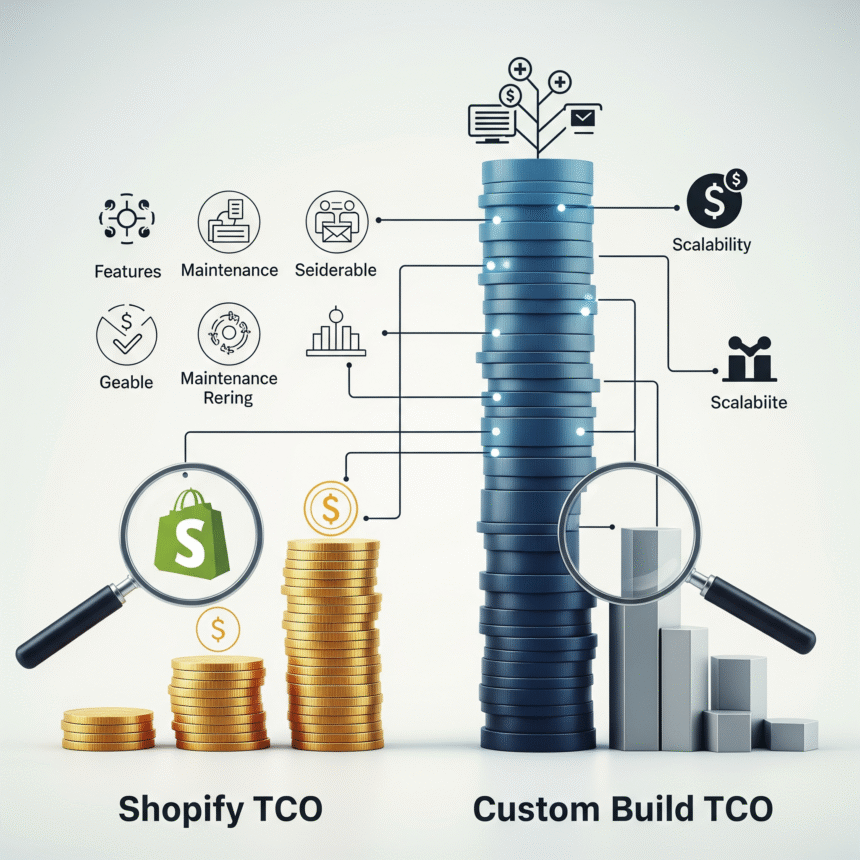
E-commerce revenue is expected to grow by nearly 50% over the next five years. This statistic highlights a critical choice for C-level executives. The biggest initial strategic challenge is platform selection. Should your business rely on an all-in-one SaaS solution like Shopify? Or should you invest in a completely custom build? This choice dictates your entire digital strategy. It defines your agility, costs, and ultimate ceiling for growth. We will break down the Total Cost of Ownership (TCO). This analysis provides a clear, actionable E-commerce Cost Breakdown.
The E-commerce Platform Dilemma: SaaS vs. Bespoke
The choice between a managed SaaS platform and a custom build is not about features alone. It is fundamentally about control versus convenience. Shopify offers a rapid, low-entry solution. It manages hosting, security, and upgrades automatically. Conversely, a custom build grants unlimited control. It allows for highly specific business logic and proprietary features.
A custom build gives you ownership of the source code. You dictate the technology stack and hosting environment. This freedom comes at a significant financial cost. SaaS platforms like Shopify streamline the operation. They simplify the technology burden for the business.
In 2025, the fastest-growing e-commerce businesses are using technology as a competitive weapon, not just a storefront. Our insight shows that when unique business processes drive the user experience, the Total Cost of Ownership (TCO) of a custom platform often yields higher long-term ROI.”
— Sociazy Content Team Insight
SaaS vs. Custom at a Glance
| Feature | Shopify (SaaS) | Custom Build |
| Initial Cost | Low (Subscription + Theme/Apps) | High (Development Team Fees) |
| Time to Launch | Days to Weeks | 3 to 9+ Months |
| Maintenance | Handled by Vendor | Fully In-House or Outsourced |
| Flexibility | Limited to App/API Ecosystem | Unlimited (Full Code Control) |
| Core Value | Speed, Simplicity, Reliability | Customization, Performance, Ownership |
Deep Dive: Shopify’s Total Cost of Ownership (TCO)
Shopify’s TCO is often underestimated by early adopters. The low monthly subscription fee is just the starting point. Businesses must account for four major recurring cost centers.
1. Core Subscription and Fees
The base plan is predictable. However, transaction fees can be significant. If you use a third-party payment gateway, Shopify charges a fee. Higher-volume businesses usually need Shopify Plus. This starts around $\$2,000$ per month.
2. App and Integration Ecosystem
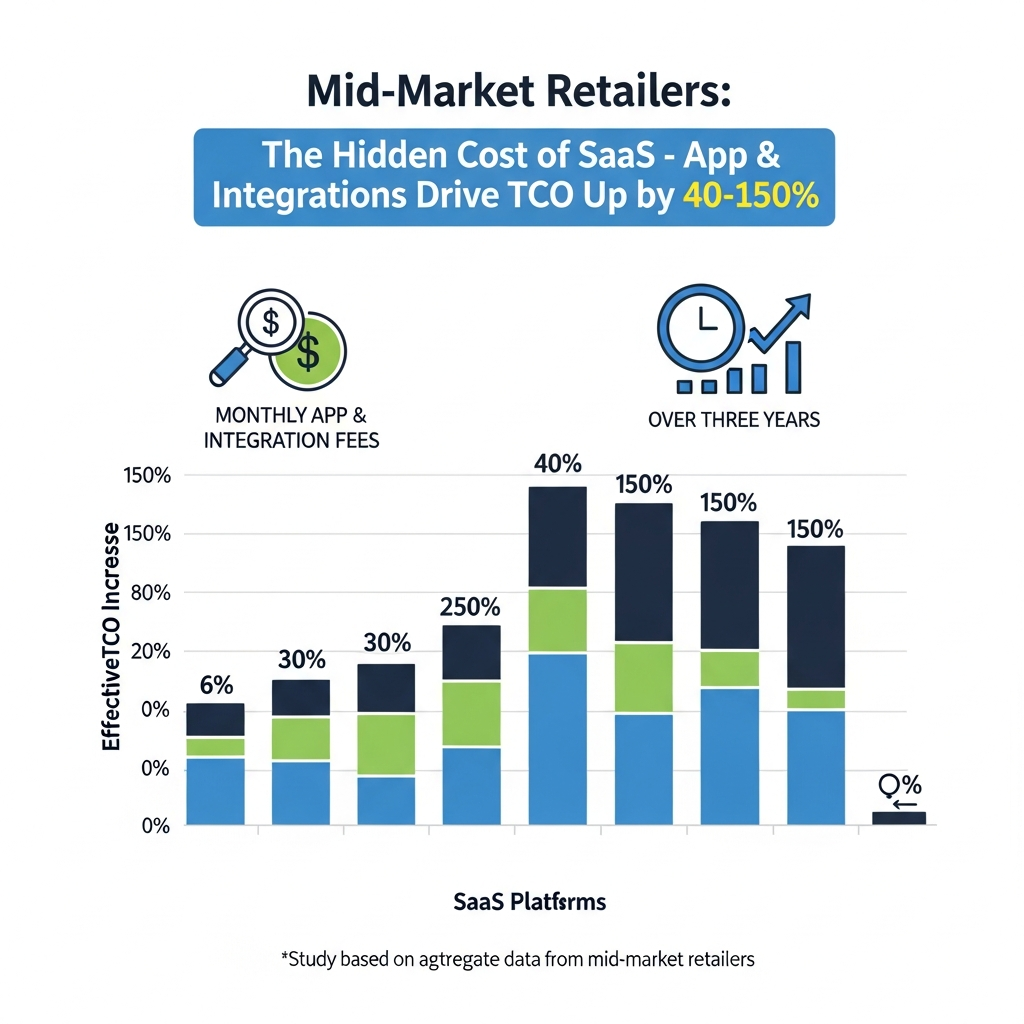
Core functionality often requires paid apps. These apps cover advanced features like complex subscriptions or specific fulfillment rules. These subscriptions add up quickly. A necessary stack of third-party tools can exceed the core platform fee.
3. Custom Development and Design
Out-of-the-box themes are not sufficient for mature brands. Customizing a theme or developing a headless Shopify storefront adds cost. A custom Shopify build can range from $\$10,000$ to over $\$150,000$. This relies on the complexity of the design.
4. Maintenance and Upgrades
While Shopify manages the core code, your apps and theme need maintenance. API changes break integrations. Ongoing maintenance costs for a custom theme are mandatory. Budgeting for these updates is crucial for IT consulting.
The True Expense of a Custom E-commerce Build
A custom build means using open-source frameworks like Magento or building from scratch with a headless commerce architecture. The initial investment is high. However, the long-term cost profile is different. This E-commerce Cost Breakdown shows initial investment ranges from $\$50,000$ to over $\$500,000$.
1. Initial Development and Launch
This is the largest upfront cost. It includes discovery, UI/UX design, front-end development, back-end logic, and rigorous Quality Assurance (QA). A fully customized checkout flow requires significant effort. Digital transformation is a serious investment.
2. Infrastructure and Hosting
You own the platform, so you own the hosting. This means paying for dedicated or cloud services (AWS, Azure, GCP). High-traffic stores need a robust, scalable setup. This is a recurring operational expenditure (OPEX).
3. Ongoing Maintenance and Security
This is the hidden cost of ownership. You are fully responsible for security patches and platform updates. You need a dedicated DevOps team or a retainer with an agency. Neglecting this leads to major security risks and technical debt.
4. Integrations and Custom Features
Creating seamless integrations with your ERP, CRM, and WMS is complex. The cost of building and maintaining these custom APIs is high. This is where a custom build excels but also drains the budget. The Total Cost of Ownership includes all these services.
Critical Factor 1: Long-Term Scalability and Flexibility
The core differentiator is long-term flexibility. A custom solution is built for your business, its specific growth model, and its unique challenges. Shopify’s scalability is bound by its platform-imposed limitations. You may face constraints on complex product configurations or customized B2B pricing models.
Custom Build Advantage: The architecture is designed to handle massive, unpredictable traffic spikes without paying a premium to a third party. The entire infrastructure is optimized for your performance needs. This ensures a superior customer experience during peak seasons.
Critical Factor 2: Integration Complexity and ERP/WMS
Integration is a core concern for digital strategy. Large E-commerce operations rely on Enterprise Resource Planning (ERP) and Warehouse Management Systems (WMS).
- Shopify: Integration relies on pre-built apps or the Shopify API. Complex, bi-directional data flow can be challenging and costly to stabilize.
- Custom Build: You design the integration layer precisely. This ensures real-time, high-fidelity data sync with legacy systems. Full control over the custom build API eliminates vendor dependency. This is a crucial element for IT Consulting strategy.
Real-World TCO Example: Mid-Market E-commerce
Consider a mid-market retailer ( $\$15 \text{M to } \$50 \text{M in online sales}$).
Shopify Plus (3-Year TCO):
Subscription: $\sim \$75,000$ ( $\$2,000/\text{month} + \text{transaction fees}$).
Apps/Integrations: $\sim \$60,000$ ( $\$1,600/\text{month}$).
Initial Custom Theme/Launch: $\sim \$50,000$.
Total: $\sim \$185,000$ (Excluding marketing/operations).
Custom Headless Build (3-Year TCO):
Initial Build (Development/QA/Design): $\sim \$200,000$.
Hosting/Infrastructure: $\sim \$36,000$ ( $\$1,000/\text{month}$).
Ongoing Maintenance/DevOps: $\sim \$108,000$ ( $\$3,000/\text{month}$).
Total: $\sim \$344,000$ (Excluding marketing/operations).
While the initial Shopify cost is lower, the custom build offers superior technical control. The custom option provides long-term flexibility and better integration fidelity. The decision is not about initial cost. It is about maximizing lifetime business value.
Making the Strategic Decision for Digital Transformation
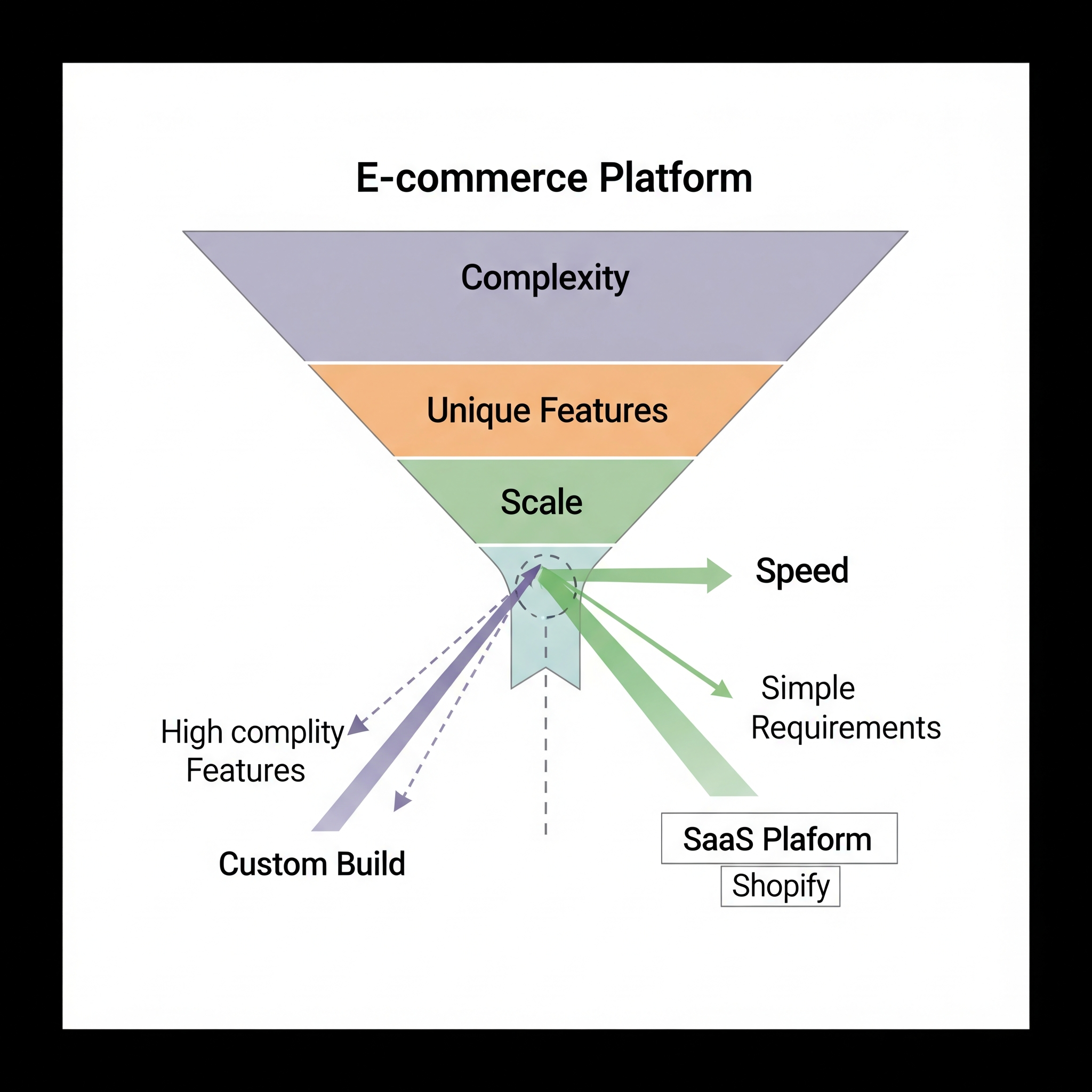
Choosing your e-commerce platform is a defining moment for your business. The E-commerce Cost Breakdown clearly shows two distinct financial models. Shopify favors low upfront capital expenditure (CAPEX) and high ongoing operational expenditure (OPEX). A custom build demands high initial CAPEX but delivers greater control over future OPEX.
For businesses with unique products, complex back-end needs, or a mandate for proprietary customer experiences, the custom build offers a stronger foundation. It is the ultimate digital transformation solution. It allows you to build a true competitive advantage.
Ready to Transform Your E-commerce Strategy?
Stop wondering and start transforming. Contact Sociazy’s expert team today for a no-obligation consultation on how we can solve your specific E-commerce challenges.
Book Your Free Consultation