
The Sprint Is Over. Why Did Nothing Change?
The sprint is over. Features are shipped. Yet, nothing changes. Key metrics are flat. Churn is steady. It is known that nearly 50% of product organizations struggle to link their work to business outcomes, according to Gartner. Execution is often blamed. The dev team is called slow. The budget is cut. The truth is more dramatic. Your product roadmap is failing. The plan itself is the problem, not the execution.
The ‘Feature Factory’ Trap (And Why You’re In It)
Your team is busy. Everyone is working hard. The roadmap is a long list of features. “Add widget X.” “Integrate API Y.” “Redesign dashboard Z.” This is a feature factory. Success is measured by output, not outcome.
This common product roadmap mistake is deadly. It guarantees high activity. It delivers zero guaranteed value. Teams are rewarded for shipping features. They are not rewarded for solving customer problems. This creates a deep product strategy disconnect.
Symptom 1: Your Team Is Chasing a Ghost
Your engineers are brilliant. They are hired to solve complex problems. Yet, they are treated like an assembly line. They are given detailed feature specs. They are told what to build. They are never told why.
This is a critical failure. A “why” is the strategic context. “We are building this to reduce churn by 2%.” Or, “This feature must improve new user activation by 10%.” Without this, the team cannot make smart trade-offs. Their innovation is stifled. Your product roadmap is failing them.
Symptom 2: You’re Building Your Competitor’s Product
Look at your current roadmap. How many items are there because a competitor has them? This is a reactive, fear-based strategy. It is not a product strategy.
A product roadmap is failing when it is a “me-too” checklist. You are simply copying features. This assumes your competitor knows your customer better than you do. It also traps you in a race to parity. You are never innovating. You are just catching up. A better is needed.
“Stop building feature lists. Start building outcome-driven roadmaps. An engineer who understands the ‘why’—like ‘reduce onboarding friction’—will build a better solution than one told to ‘add a 5-step tutorial’.”
— Sociazy
The #1 Reason: Your Roadmap Is Not a Strategy
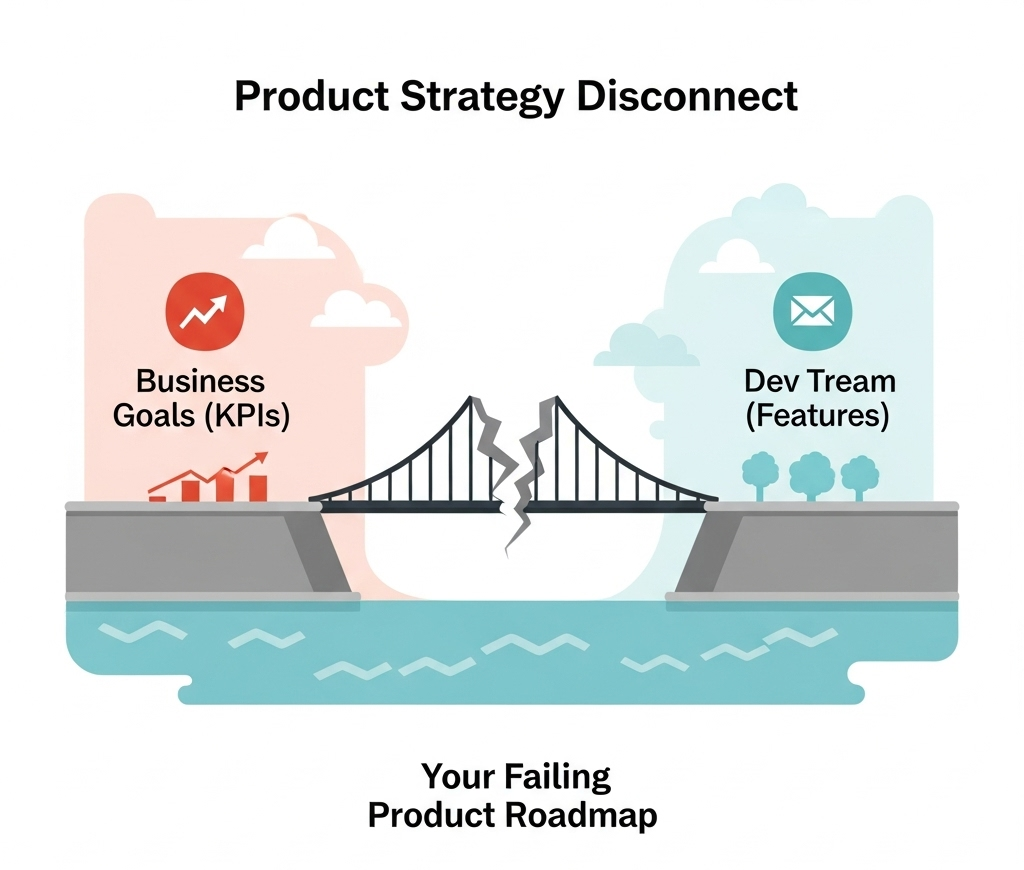
Here is the hard truth. The #1 reason your product roadmap is failing is this: It is a list of features, not a strategic plan. It is a tactical document. It is completely disconnected from your high-level business goals.
Your CEO has KPIs. Increase market share. Reduce churn. Enter a new segment. Your roadmap should be the direct bridge to those goals. Instead, it is a document full of “stuff to build.” This product strategy disconnect ensures that even a perfectly executed plan will fail to move the business forward.
Case Snippet: How We Fixed a ‘Stalled’ Product Roadmap
A B2B SaaS client was stuck. Their roadmap was full. Their team was busy. But their “new user activation rate” was stagnant for a year. They were in the feature factory.
Sociazy’s was engaged. We did not build new features. We stopped development for two weeks. We focused only on user interviews and data analysis.
The insight was found. Users were dropping off at a single, confusing step. The roadmap was changed. The only goal for the next quarter was: “Solve the ‘Day 1’ activation drop.” The team, now armed with a “why,” built a brilliant solution. The activation rate improved by 30%.
The Solution: From Feature Lists to Outcome-Driven Roadmaps
How is this fixed? You must shift from outputs to outcomes. This is the “outcome-driven roadmap.” Instead of listing features, your roadmap should list problems or goals.
- Old Way (Feature): “Q3: Build new analytics dashboard.”
- New Way (Outcome): “Q3: Increase user data engagement by 25%.”
This simple change is transformative. It empowers the team. The designers, engineers, and product managers can collaborate to find the best way to achieve that 25% lift. A dashboard might be the answer. But a better weekly email report might be faster and more effective. This model, championed by product thought leaders like , unlocks true innovation.
Your Golden Takeaway
Your roadmap is not a project plan. It is a tool for communication. It is a statement of strategic intent. Its job is to align the entire company. It shows how the day-to-day work will achieve the high-level business vision.
The golden takeaway is this: A good roadmap measures success by business outcomes, not by shipped features. If your product roadmap is failing, it is because it is measuring the wrong things.
Conclusion
Stop blaming your developers. They are building what they are told to build. The failure is not in the code. It is in the connection of that code to the business.
When your roadmap is a list of features, you get a feature factory. When your roadmap is a list of customer problems to solve, you get an innovation engine. Your team is ready. They just need the right map.
Escape the Feature Factory Is your roadmap a list of features or a plan for growth? If you are stuck in the feature factory, we can help.
Sociazy’s Product Strategy & UX Audits are designed to find the “why” that will unlock your team’s potential.